
By Greg Woodman
In a time when college or professional football played in college towns is driven by money, ego, and instant gratification, Penn State has an opportunity. This is not just about hiring a new coach. This is about reaffirming who we are and what kind of leadership we believe in.
What if we flipped the script?
Or better yet, what if we returned to our original script?
Because this moment is not new. In the 1970s and 1980s, when college football was becoming commercialized, Penn State stood apart. It wasn’t just building a football program. It was building a value system.
Back then, we weren’t chasing headlines. We were building a brand that stood for academics and athletics, success and honor, character and championships. When others moved toward flash and profit, we doubled down on discipline, humility, and legacy.
Now, we’re at another turning point. And while the temptation to throw $12 to $14 million a year at the next big name is real, so is the opportunity to do something far braver.
What if interim head coach Terry Smith said, “Pay me $2 million and use the other $10 million to keep our best players, invest in NIL, and build something sustainable”?
That would not be a cost-saving move. That would be a clarity move.
It would signal that culture still matters and that the leader is not the star, but the Guide and the steward. Think Yoda the guide not the hero Luke Skywalker.
Every Revolution Starts with a Contrarian
In business, some of the most iconic brands were born by running toward values while everyone else sprinted toward scale.
Sam Walton built Walmart by going where Sears would not, into rural, underserved communities.
Southwest Airlines flew short hops with free bags when the rest of the industry chased hub-and-spoke prestige.
Nike was once the underdog. Blue Ribbon Sports become Nike and knocked off Adidas and Converse not with flash, but with grit, authenticity, and belief in the long game. Plus, they choose not to even manufacture the shoes but outsource them!
Converse had Larry Bird, Magic Johnson, and Dr. J. They had stars and the 1970’s was Number 1. But Nike had a different playbook and now owns Converse.
It’s the same playbook that Babson College is using today — the one that just helped them outrank MIT, Cornell, and Penn in the Wall Street Journal’s 2024 college rankings, finishing second only to Stanford. Why? Because Babson doesn’t just teach entrepreneurship as a major. They teach it as a mindset; a cultural capability embedded into everything they do.
Here’s the irony: Penn State already has that same playbook. We offer the same programs. We have the same entrepreneurial talent and even deeper resources. But we’re not in the top 100. Why?
Because we haven’t aligned around it — yet.
And yet, we see the blueprint all around us in Happy Valley. It’s alive in the enduring cultures built by Cael Sanderson, Char Morett-Curtiss, Russ Rose, Guy Gadowsky, and others.
Did we hear that very playbook yesterday from Pat Kraft?
It sure sounded like it.
In his press conference, and in the courage, it took to make a tough and necessary decision, Kraft did more than talk about change. He leaned into Penn State’s original blueprint. He spoke of character, humility, blue-collar toughness, and a shared standard. Not just winning but winning the right way.
Love Versus Fear — The Real Hiring Filter
At its core, every leadership decision is a choice between love and fear.
Fear hires the biggest name to avoid criticism.
Love hires the right leader to build something that lasts.
Fear is reactive. Love is aligned.
Terry Smith stood at the podium and said,
“I love this place.” I want to give back to the community that gave to me.”
He didn’t say he wanted to be the next headline. Or to be the first this or that. He said he wanted to be the next servant.
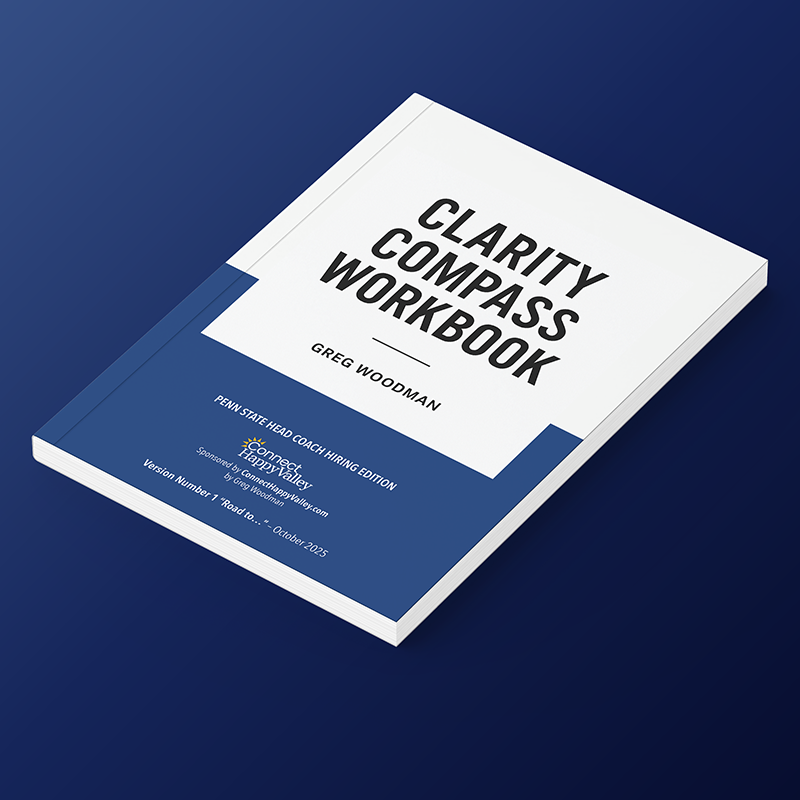
That is the filter we use in the Clarity Compass Workbook — a tool for trustees, leaders, and alumni to evaluate candidates based on alignment with who we are.
It includes:
- Pat Kraft’s published coaching criteria
- Research from The Captain Class and Good to Great
- A “Love vs. Fear” leadership model
- Game-day culture trackers.
- Scorecards and cultural vetting by Penn State’s most respected leaders
As Jim Collins writes in Good to Great:
“Level 5 leaders channel their ego needs away from themselves and into the larger goal of building a great company. Their ambition is first and foremost for the institution, not themselves.”
That is exactly the kind of coach Penn State needs. Not someone who plays the hero, but someone who builds the culture and plays the guide.
Download the Clarity Compass Workbook.
Join the conversation. Lead with clarity. Build with love.
Because the future of Penn State will not be bought. It will be built.

3 Responses
Thank you, Greg, for publishing an article that speaks to values as much as it speaks to victory. As you teach, it’s not either/or. It’s values AND victory.
I wonder, what might Penn State outline – dare I say “sell” – as the Penn State athlete’s journey? How can Penn State inspire the world’s greatest players and coaches to put their future in The Lion’s hands (paws)?
If you get a back stage tour of Penn State’s recruiting pitch, you’ll see it includes a truckload of swag and life-size glamour shots of former players. It’s sexy but not substantive. And I gotta believe that for a world class coach or athlete, the setup is the same wherever they go. Every school trying to outdo the other with nicer swag, better locker rooms, bigger NIL dollars, and empty promises of NFL futures. It’s a race to the bottom.
Could the pitch also include, for example, success stories about Penn State athlete success after their playing days? A pledge to guide its players and coaches for years to come in the types of entrepreneurial adventures that Stanford offers?
Beyond swag and glamour shots and an annual White Out, how does Penn State prove its values are worth more than its dollars?
If ever there were a sales pitch that you could build, this is it. How do we get you on the roster?
Thanks, Ben, for the comment. Terry Smith has recruited 60% of our current players. They call him OG. I would just listen to his heart-to-heart connection with an athlete and use that in all marketing materials. This guy is a Servant Leader. It is going to be great to watch how the team rallies this week and the rest of the season. This is a live laboratory on what is leadership is in world that favors fear over heart. We get to see heart and how authentic tough “love” is executed.
The future of PSU will CONTINUE to be built (not bought) on its heritage and culture. PSU was in many headlines decades ago for many great reasons, e.g. proving academics and athletics can work together. It was also in the headlines by the envious crowd doubting the honesty of the program. When PSU stumbled they were quick to point their fingers at us. I’m hoping Terry Smith is the one to continue doing the building for the football program. Thankfully much of the glitz is in place (weight room, other facilities) so he can focus on building the team PSU wants.
Can PSU build a Babson college model or more appropriately bring back that model? Lots of moving parts in the faculty senate. Will there be a day when Coach Gadowski, Sanderson, Smith stand in front of the BoT and implore them to use athletics if needed to build on their academic/research opportunities? I hope so for everyone’s betterment.