A diagnostic look at why interdependence faded and why community ownership is quietly returning.
A Capable Town with a Hidden Gap
State College is a well-run, affluent, and highly capable college town. Emergencies are handled swiftly. Services are accessible. Institutions respond when needed. By conventional standards, the system performs well.
And yet, many residents quietly feel like renters in their own hometown rather than owners.
That feeling is not imagined. It is structural.
The Outsourcing of Interdependence
Over time, interdependence has been quietly outsourced.
Neighbors are no longer our first responders.
Informal gatherings have given way to formal schedules.
Early requests for help have become late-stage crises.
State College remains strong on emergencies and competent in managing chronic needs. What it lacks is everyday activation—the quiet, consistent social cues that encourage people to connect, contribute, and care.
People are ready to show up.
Hosts are prepared to welcome them.
But the patterns no longer prompt that engagement.
The Emergence of the Renter Mindset
Without invitations or cues, life becomes more efficient but less communal. Schedules tighten. Interaction shrinks. Risk is minimized. The everyday texture of community is lost.
This is how capable individuals begin to feel like temporary occupants rather than stewards of place.
This pattern is known as institutional substitution. As systems became more effective, social bonds weakened. Not because people stopped caring, but because their care was no longer essential to the system’s function.
As a result, the town remains operational, but it no longer feels personal.
Where the Gaps Appear
These gaps are not visible emergencies. They are subtle, human-scale needs:
- A senior who can no longer drive but does not qualify for services.
- A caregiver quietly burning out with no one noticing.
- A newcomer who becomes isolated after losing a job
These are the types of moments that once would have been seen and supported by community. Today, they often go unseen until the damage is more difficult to reverse.
The Critical Role of Hosts
At the center of community resilience are the Hosts. These are the café owners, nonprofit directors, venue operators, local shopkeepers, and cultural organizers who hold space for the rest of us. They provide the Third Places where human connection is possible.
Hosts are not just providers of coffee or events. They are curators of community memory, first responders to social disconnection, and often the unrecognized emotional infrastructure of a town.
And yet, Hosts are expected to keep showing up with generosity and warmth, even when their own reserves are low. Many work long hours. They absorb economic pressure and emotional strain. They hold space for others without anyone holding space for them.
When Hosts lose support, they begin to burn out.
When Hosts burn out, places thin out.
When places disappear, the connective tissue of a town unravels.
This unraveling does not happen in one dramatic moment. It happens slowly, as people stop showing up and Hosts are left without reinforcement.
What Remains When Institutional Trust Thins?
Trust in institutions is thinning. Government, media, corporations, and even nonprofits are increasingly viewed with skepticism.
If that trust continues to fade, what remains?
The answer is interdependence.
Historically, community carried what systems could not.
Neighbors noticed what services missed.
Hosts created spaces for belonging.
Local nonprofits carried continuity and care.
When those pathways are weakened, a town may still function. But it stops feeling like it belongs to the people who live there.
Why Connect Happy Valley Exists
Connect Happy Valley exists to restore everyday pathways to connection. Not by inventing community, but by making it easier to access what is already here.
This is not a moral failure. It is a byproduct of efficient systems unintentionally displacing human rhythms. What is needed now is intentional reconnection.
Support for Hosts must become normal again.
Informal care must be visible again.
Neighbors must be cued to step forward again.
Whether there is appetite for this shift cannot be assumed. It must be tested.
Testing the Shift: Two Community Initiatives
This week is not a launch or campaign. It is a diagnostic experiment. Two initiatives are testing whether residents are ready to reclaim a deeper sense of local ownership and communal life by simply showing up.
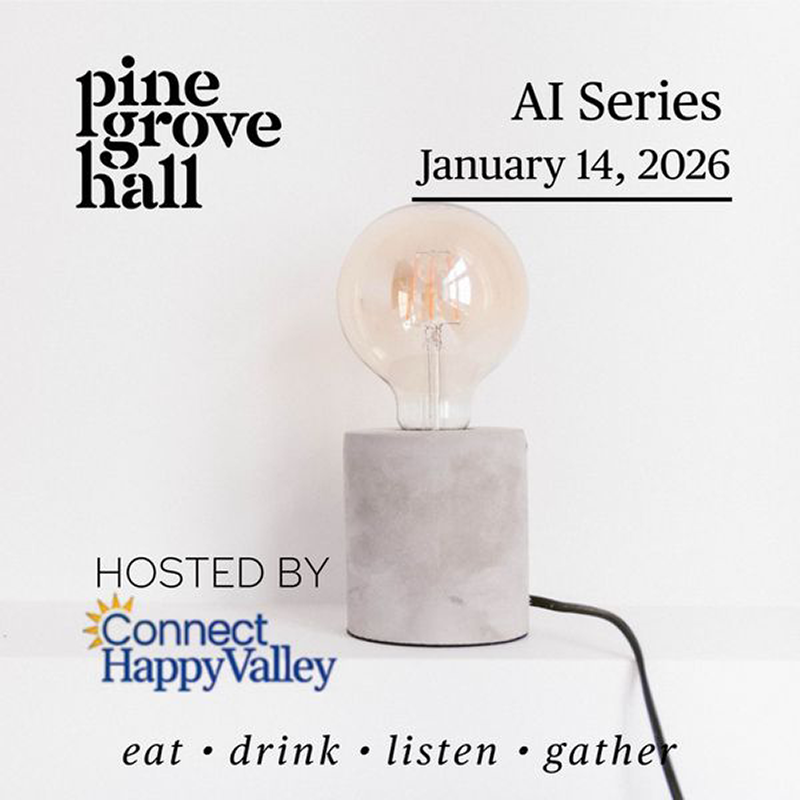
Initiative One: Community Conversations with Nittany AI Alliance
A series of discussions focused not just on technology, but on neighbors (who happen to be Ai world class credentialed Penn State Ai experts) having dialogue with neighbors—town and gown over a beer theory. These gatherings emphasize real conversation in real rooms. Researchers, educators, and neighbors choosing connection over abstraction. Tonight, Wednesday at Pine Grove Hall starts at 7. Come early and grab a beer, or the complimentary shrub soda. Reserve your spot.
Initiative Two: Stirred, Not Stuck – Jump Start 2026
Sunday, January 18 from 5:00 to 7:00 PM
Upstairs Listening Room, hosted by Melissa Hicks
As the second initiative, this gathering is a new kind of offering: a relaxed, small-format evening designed to support locals in reimagining their year ahead. It is hosted by Melissa Hicks, a community-rooted learning designer, who holds space for personal reflection and small-group dialogue.
Attendees will explore what is working, what needs resetting, and what small experiments they want to try in 2026. This is not a boot camp. It is a plain-English, low-pressure design lab. Guests will leave with a few thoughtful, doable tweaks to carry into their everyday life. Learn more.
The goal is simple: to offer a space where people can feel stirred, not stuck. To re-engage community energy. And to give Hosts like Melissa the space, support, and recognition they deserve.
When people show up for events like this, it sends a quiet signal.
The signal says Hosts matter.
It says community care is not optional.
It says this town is not just where we live, but something we share.

3 Responses
Greg, 2026 greetings to you! What a fantastic article — and spot on. My husband and I look forward to attending both events and meeting others who are interested in community building.
Greg and Melissa, thank you for being some of the Hosts and giving back to our community.
This was a great, thought provoking article.
I wish I could have attended these events. Unfortunately I was out of town. I found this article very interesting. It reminded me of my time in the Navy. The individual units (squadron, ship etc) became the community. There was a strong community feel with unspoken support especially when spouses were deployed for months at a time. That community feel was the first thing my wife and I noticed we missed when we left the Navy. I used the term “we” because my wife was as much a part of that community as I was even though she didn’t wear the uniform.
Keep the ideas/article coming. Love the thoughts, ideas and initiatives.