
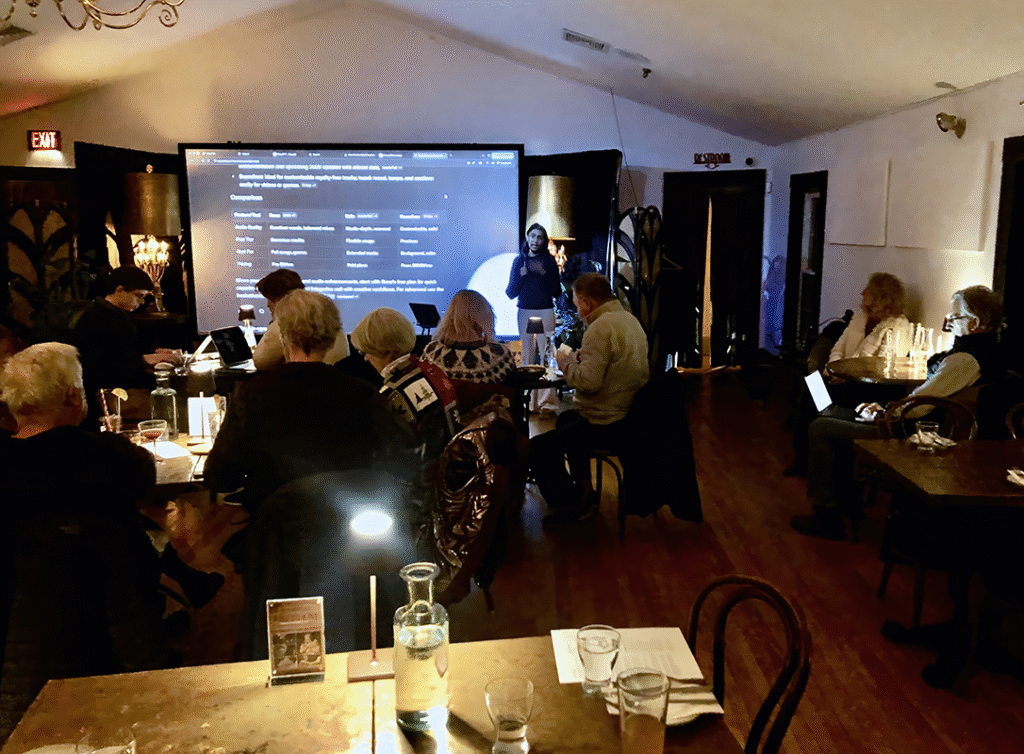
After attending the Nittany AI Series event at Pine Grove Hall last Wednesday and in discussions with three Penn State student presenters — Kartikay Pandey, Kanika Gupta and Oviya Raja, Frank Archibald submitted this article… AI Exposes the Gap…
By Dr. Frank Archibald
For years, I assigned case studies the way most instructors do: present a business scenario, outline options, and ask student teams to choose the best path forward. Predictably, teams would select an option, then extract data from the case to justify their choice. They were doing exactly what school had trained them to do—identify a correct answer and support it with evidence.
But I realized something critical was missing. In the professional world, no one rewards you simply for picking an option and explaining why you like it. What matters is whether you can convince someone with authority and risk exposure to act on your recommendation.
So, I changed the assignment. Instead of asking teams to “analyze the case,” I required them to recommend a course of action to me—and persuade me to accept it. The class became a decision forum. I became the decision-maker they had to convince. Their success depended not on whether I agreed with their choice, but on whether they could build a compelling, defensible argument that withstood scrutiny.
That shift—from picking an option to convincing a decision-maker—changed everything.
The Cognitive Transformation
Students quickly discovered that selecting an option is far easier than defending one. To defend a recommendation, they had to clarify decision criteria, identify trade-offs, quantify risk, address counterarguments, anticipate objections, and communicate uncertainty honestly. Most importantly, they had to take ownership.
They moved from “Here’s what we think” to “Here’s what you should do—and why you can responsibly commit resources to it.” This is not merely analytical work. It is professional work.
What the Professional World Demands
In real-world settings, the standard is far higher than classroom correctness. Consider what professionals face:
In engineering design reviews:
- Demonstrate technical validity with explicit assumptions.
- Conduct sensitivity analyses and identify failure modes.
- Justify costs and explain rejected alternatives.
- Defend decisions under questioning and accept accountability.
In boardrooms and executive briefings:
- Align recommendations with strategic objectives.
- Model financial impacts and assess stakeholder effects.
- Address regulatory and ethical implications.
- Present implementation feasibility and contingency plans
In consulting environments:
- Translate technical analysis into decision language.
- Surface trade-offs transparently and prepare for pushback.
- Manage uncertainty while protecting credibility.
- Communicate effectively with non-expert decision-makers.
In public policy settings:
- Anticipate political resistance and competing interests.
- Build coalition support with defensible data.
- Frame implications for diverse constituencies.
Notice what’s absent: no one is rewarded merely for being analytically correct. Professionals succeed by being convincingly correct under scrutiny.
Where Education Falls Short
K–12 and undergraduate education have historically emphasized correctness, coverage, formulaic arguments, and individual performance. Students learn to solve problems, author essays, pass exams, and cite sources.
But they rarely practice defending recommendations to skeptical authorities, managing live objections, owing uncertainty, or accepting decision accountability. While some domains—law schools, debate programs, certain business schools—have built decision advocacy into their pedagogy, across mainstream education this remains marginal rather than central.
Graduates often enter the workforce highly capable of producing analysis, yet unprepared to defend and advocate for it.
AI Exposes the Gap
Artificial intelligence is making this deficiency impossible to ignore. AI can now generate case summaries, produce analyses, run simulations, draft recommendations, and suggest alternatives. If education remains focused on answer production, AI appears to undermine learning.
But if education shifts toward decision advocacy, AI becomes a powerful tool. The emerging professional reality is clear: AI produces options and analysis; humans validate, select, endorse, and defend.
The scarce skill is no longer generating information—it’s exercising judgment, framing decisions, convincing stakeholders, managing risk, and accepting responsibility. Students trained only to “produce answers” may misuse AI. Students trained to “defend decisions” must understand AI deeply because they must stand behind its outputs.
AI does not eliminate human responsibility. It intensifies it.
The Path Forward
When schools prohibit AI without redesigning assignments, they reinforce an outdated model centered on production rather than persuasion. When students graduate without ever defending a consequential recommendation to a skeptical audience, they enter the workforce cognitively undertrained.
The shift from picking an option to convincing a decision-maker is not a minor pedagogical tweak, it’s a transformation in educational philosophy. It reframes learning as judgment under uncertainty, responsibility under scrutiny, and convincing grounded in evidence.
In the professional world, credibility belongs to those who can say: “Here is our recommendation. Here are the risks. Here is why it’s still the best course. And we stand behind it.”
That is the skill students need. AI will not replace it. AI will only reveal how urgently it must be taught.
Frank worked in the aerospace industry and at the end of his career in the Water Tunnel as an ARL employee for 20+ years. While there he taught several mechanical engineering courses and for 15 years a two-semester-sequence capstone design course in the Master of Manufacturing Management 1-year MSc program. It was this course that is referred to in the article and where he realized the misalignment of undergraduate education with the needs of professionals. He now volunteers at Discovery Space and The Rivet and advises students in the Penn State Wind Energy Club as they compete in the Collegiate Wind Competition run by the Dept of Energy.

6 Responses
In other words, become a salesperson. A good salesperson – lay out the basics of the problem or issue, why someone should go with your product or service, how it will benefit them, then make the call to action. Dr. Archibald is correct, and good salespeople have been making this case since forever. AI won’t replace a good salesperson, a human trying to reach other humans. And we need more good salespeople in all venues.
Well said Scott, “human trying to reach other humans”. AI makes technical intelligence cheaper.
Human intelligence becomes more valuable.
The future belongs to people who understand people.
Spot on Scott.
Crazy to think that we don’t teach basic “sales” techniques at any level.
These skills are essential for all age groups and in today’s world. Everyone is a walking product, service, brand, and image that needs to be managed and promoted in order for us to prosper.
Warning: ChatGPT generated content ahead
In addition to training students to construct decision proposals, higher education should include structured training on being on the receiving end of a decision advocate’s presentation — whether that presentation is AI-supported or not. Evaluating a proposal under uncertainty is a distinct skill from creating one.
Enterprise leaders live with the consequences of their decisions and may lose their positions if wrong. While it is often assumed that such pressure improves proposal quality, career risk, reputational concerns, and organizational politics can just as easily bias decision-makers toward defensible choices rather than optimal ones.
Large language models introduce an interesting counterweight. LLMs are highly influenced by prompt and context — a risk that has always existed in human framing as well — but they can also be used to critically review a decision advocate’s presentation. When structured properly, AI can surface alternative assumptions, identify hidden trade-offs, and challenge politically safe but analytically weak reasoning.
Playing devil’s advocate, one could argue that an AI system — unburdened by fear, ego, or political survival — may produce recommendations that are more analytically consistent and less psychologically compromised than those produced under human pressure. The more important question may not be whether AI replaces human judgment, but how it can be integrated as a disciplined analytical counterweight within high-stakes decision processes.
John this is quite the powerful analysis and contribution to the discussion. “Playing devil’s advocate, one could argue that an AI system — unburdened by fear, ego, or political survival — may produce recommendations that are more analytically consistent and less psychologically compromised than those produced under human pressure.” And to me sums up why Higher Ed must cheer on Ai verse being afraid of it and any second denying the use of this tool is not “good judgement”—but that would require one to be unburdened by fear, ego and political survival.
Thank you all for your comments. I plan on publishing two more articles, at least, on this topic of AI and education. AI is and will be changing the work place dramatically and will require a significantly different instruction approach – commensurate with the change it will make in the work place. Hopefully the articles can have an impact on making this change.