


March 4, 2026
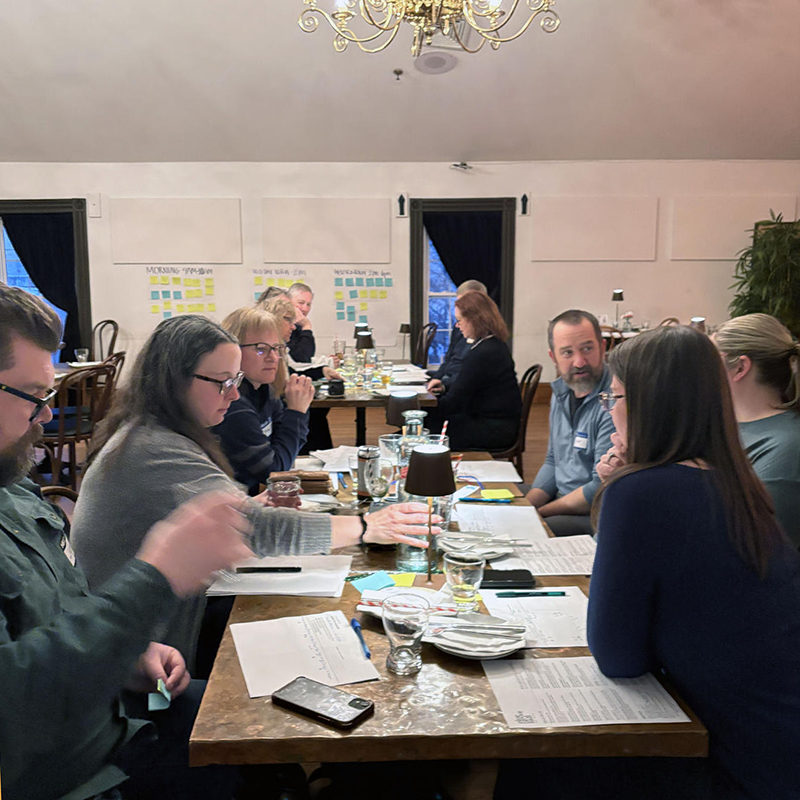
A few weeks ago, a few tables of people sat together at Pine Grove Hall in State College and did something quietly radical. They mapped their days.
Not their calendars. Not their productivity. Their energy. Yellow sticky notes for high points. Blue for low. Morning, midday, afternoon, evening, and the unique patterns that do not fit a neat schedule. When all the notes went up on the wall, the picture was honest and a little humbling. Mornings held more yellow. The afternoons were full of blue. Evenings came alive again when people were with family, outside, with a dog, or doing something they actually chose.
It turns out that is not just personal. It is a pattern researchers have studied for decades in places where people live longest and feel most connected. They call them Blue Zones. And when you look at what makes those communities thrive, Happy Valley already has more of the ingredients than we tend to give ourselves credit for. We call ours the Blue-White Zone.
What Blue Zones Know That We Are Relearning
Researchers studying Blue Zones, regions where people routinely live past 100, identified nine shared habits called the Power 9. Two of the most consistent are “Loved Ones First” and “Belong.” People in these communities keep aging parents nearby, invest time in their families, and show up for one another consistently. The thing that extends their lives is not a pill or a diet. It is a relationship. It is a room.
Happy Valley already has some of this woven into its fabric. Neighbors greet each other every day. Volunteers deliver meals through State College Area Meals on Wheels. Penn State connects people from downtown State College to small towns across the valley. There is a culture here, imperfect but real, of showing up for one another.
But many of us have drifted from those rooms. We are overextended, quietly lonely, and carrying more than we should carry alone. And when adults lose that sense of purpose and belonging, we cannot model it for the next generation either. The Stirred, Not Stuck sessions are, in their own small way, rebuilding that kind of room right now.
The Meaning Gap We Are Leaving in Our Kids
Here is the part that deserves more honest conversation: we are not passing these lessons forward.
An instructor recently told me that a student came to him and said she did not know what she wanted to do with her life. When pressed, she said she wanted to be famous. Not to do something meaningful. Not to help anyone. Famous. On Instagram. On TikTok.
She is not the villain in that story. She is the product of a culture that has overscheduled children, removed most of their natural consequences, and replaced boredom and struggle with sports camps and screen time. Research shows that overparenting is a direct predictor of entitlement in young adults, linked to lower self-efficacy, higher anxiety, and poor relationship quality. When we solve every problem for our kids, we accidentally rob them of the skills that build meaning.
Service is one of the most reliable antidotes. People who volunteer regularly report lower depression, higher life satisfaction, and a stronger sense of purpose, regardless of age. They also show lower cortisol, a biological marker of stress. Kids who serve alongside adults in real situations learn something no camp or curriculum can teach that showing up for others is its own kind of fuel. That is a Blue Zone principle. It is also a Blue-White one.
Small Experiments, Real Change
The good news is that none of this requires a grand overhaul. It starts with small, honest choices, made in community, exactly like what happened at Pine Grove Hall.
Participants were not solving the loneliness epidemic. They were writing experiment cards. One caregiver found a two-minute reset in the middle of the day. One retiree added a gentle morning anchor to replace the structure that used to come from a job. One person doing work they no longer love started naming it out loud, which is the first step toward changing it.
These are yellow moments in the making. The Blue Zones did not happen because everyone overhauled their lives at once. They happened because small choices, made inside strong communities, added up over time. Happy Valley has the raw material: the roots, the relationships, the pride, and the people. Stirred, Not Stuck is one small room helping us remember that.
The next session focuses on habits. It meets Sunday, March 15, from 5 to 7 p.m. at Pine Grove Hall. The event is free. Seats are limited: https://pinegrovehall.com/event/6411481/750034104/stirred-not-stuck-session-3-tiny-habits-real-life

One Response
Wow, glad I’m not the only one who thinks my generation did a disservice to our children by limiting their freedom in their youth