

Human Flourishing in the Age of Artificial Intelligence
By Frank Archibald and Greg Woodman | June 10, 2026
Over the past year, we have watched a curious phenomenon unfold on college campuses and throughout society. Graduation ceremonies that were once straightforward celebrations have occasionally become stages for frustration. Students have booed commencement speakers. Faculty members openly debate the future of higher education. Parents question whether the cost of a degree still makes sense. Employers wonder whether traditional credentials remain reliable indicators of readiness for an increasingly uncertain future.
Beneath these conversations lies something deeper than politics, economics, or technology.
People sense that something significant is changing, even if they cannot yet fully describe it.
Artificial intelligence has become the most visible symbol of that change. New tools seem to arrive almost weekly, each one capable of performing tasks that previously required years of education, training, or experience. It is not surprising that this creates anxiety. Whenever the ground shifts beneath our feet, fear is a natural response.
Yet fear rarely helps us understand what is actually happening.
The more useful question is not whether artificial intelligence will change education, work, and society. It already is.
The more useful question is what becomes more important as these tools become more capable.
One of the most enduring stories from American business involves Charles Proteus Steinmetz, the brilliant engineer whose expertise was sought whenever a particularly difficult problem emerged.
A large industrial generator had failed, and after engineers spent days trying to diagnose the issue, Steinmetz was called in. He studied the machine, climbed a ladder, made a small chalk mark on one section, and instructed workers where to make a repair.
Within minutes the generator was operating again.
When the company later questioned the size of his invoice, Steinmetz reportedly sent back an itemized bill.
Making one chalk mark: $1.
Knowing where to place it: $9,999.
The story has survived for more than a century because it captures something fundamental about expertise. The value was never in making the mark. The value was knowing where to place it.
That distinction feels especially relevant today.
Years ago, Steve Jobs observed that organizations often become so focused on process that they lose sight of content. Procedures matter. Systems matter. Efficiency matters. But none of those things represent the actual purpose of an organization.
The purpose is the value created.
The purpose is the outcome.
The purpose is knowing what matters.
Artificial intelligence is becoming extraordinarily effective at process. It can organize information, identify patterns, accelerate research, automate routine tasks, draft reports, generate code, and perform analytical work at remarkable speed. In many respects, it may become the most powerful process tool humanity has ever created.
Yet the existence of a powerful tool does not eliminate the need for judgment. In fact, it increases it.
The challenge facing schools, businesses, governments, and communities is no longer access to information. Information is abundant. What remains scarce is the ability to determine what deserves our attention, what problems are worth solving, what opportunities are worth pursuing, and what values should guide our decisions.
Those are not technical questions.
They are human questions.
For centuries, the best educational traditions understood this distinction. While universities certainly transfer knowledge, their deeper purpose has always extended beyond information transfer. At their best, educational institutions help individuals develop judgment, character, intellectual curiosity, civic responsibility, and the capacity to contribute meaningfully to society.
In other words, they help develop human beings.
That mission becomes more important, not less, in a world increasingly shaped by artificial intelligence.
The challenge facing higher education is not whether students can access information. The challenge is helping students determine what is worth paying attention to, what is worth building, what is worth defending, and ultimately what is worth dedicating a life to.
Future graduates will certainly need technical competence. They will need to understand technology and learn how to work alongside increasingly sophisticated tools. However, technical competence alone has never been sufficient for a meaningful life or a healthy society.
Communities depend upon trust.
Organizations depend upon leadership.
Families depend upon commitment.
Democracies depend upon citizenship.
None of these can be reduced to information processing.
The qualities most likely to grow in value over the coming decades sound remarkably familiar. Judgment. Wisdom. Creativity. Ethical reasoning. Communication. Mentorship. Service. The ability to build relationships and strengthen communities.
These qualities emerge from lived experience. They emerge from responsibility. They emerge from caring about the well-being of other people.
Which brings us to a word that rarely appears in discussions about technology.
Love.
Love is difficult to measure and impossible to place on a balance sheet, yet it sits quietly beneath many of the most important activities in human life. It motivates parents to sacrifice for their children. It inspires teachers to invest in students. It moves volunteers to serve their communities. It encourages citizens to participate in civic life. It drives people to build organizations, businesses, nonprofits, and institutions that improve the lives of others.
For all the extraordinary capabilities artificial intelligence may eventually possess, it cannot care. It cannot assume moral responsibility. It cannot form genuine friendships. It cannot experience gratitude, loyalty, courage, or love.
Those remain profoundly human capacities.
For that reason, we are less interested in asking whether artificial intelligence will replace people than we are in asking what kind of people we should become as these tools continue to evolve.
History suggests that technological progress often frees human beings from certain forms of labor while creating opportunities for other forms of contribution. The Industrial Revolution increased productivity. The Information Age expanded access to knowledge. The AI Age may do something equally important if we approach it wisely. It may free more people to devote greater attention to the parts of life that matter most: building relationships, strengthening communities, mentoring others, creating meaningful work, and contributing to causes larger than themselves.
If that proves true, artificial intelligence may ultimately remind us of something previous generations understood well. Human flourishing has never depended solely upon knowledge, productivity, or efficiency. It depends upon meaning, belonging, responsibility, service, and connection to other people.
Which brings us back to Steinmetz.
The value was never in making the mark.
The value was knowing where to place it.
The future will belong to people who know how to use extraordinary tools wisely. More importantly, it will belong to people who understand what matters, what deserves their attention, what deserves their service, and what deserves their love.
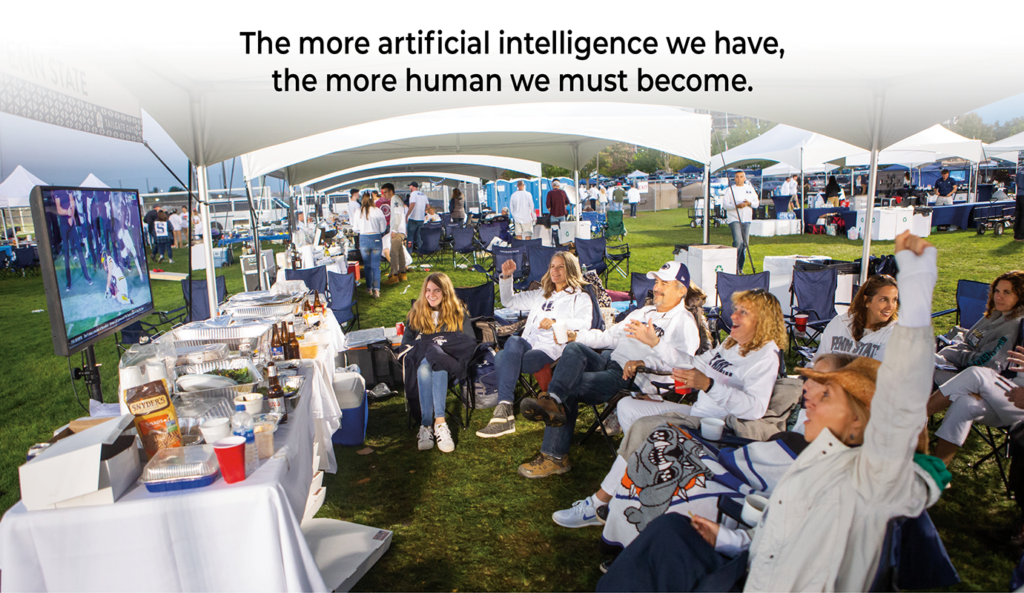
The more artificial intelligence we have, the more human we must become.
That future is not something to fear.
It is something worth building.

2 Responses
I LOVE the insightful perspective!
Excellent article. Our character will develop our love for ourselves and our neighbors!